Tuesday, January 29, 2013

Verbs of Utterance (simply a list)

"When asked to share some juicy verbs of utterance," she explained, "her Facebook friends came through big time."

Here's the list so far in order of appearance on FB:

huffed
lied
spilled
snorted
husked
spat
erupted
dribble
spat
gasped
whispered
spewed
flung
blurted
retorted
roared
mouthed
snapped
cajoled
mumbled 
grumbled
muttered
sang
trilled
observed
commented
replied
exploded
hissed
grunted
burped
ejaculated
gloated
contradicted
groused
gushed
ratted

Saturday, December 29, 2012

New Year's Love Letter: Going Back Home

I grew up on a street that was part of the Massachusetts Audobon Society, but since my parents were from deepest Brooklyn in New York, they didn't know the first thing about living in the woods. They weren't into identifying birds. Yes, it was actually a bird sanctuary. This Christmas, as usual, we stayed at my brother's house one town away from where I grew up in Sharon. Filled with gorgeous furnishings, too many to describe, it's a Victorian house on an old New England street--a house was built in 1835 for Foxboro's tailor. It's a few miles from the house where I grew up--also once cozy and beautiful, especially the living room, with its fireplace, framed paintings, and myriad oak furniture and wool rugs.

In years past, we've come back here, and communed with my parents and my brother's family, my two teen-age nieces and my brother's very stylish wife--the whole package is a perfect dose of femininity and familiarity for me and fun for my boys and husband. This year is the same, but of course, very different without my Dad. This sense of drastic change and loss must have settled in the part of my brain that makes dreams--that part that accesses my intentions early in the morning, because when I woke up on my first morning here, I'd constructed a plan to go visiting all my special places from growing up. In a sudden flash,  I understood that for the last decade, I hadn't been paying any attention to my own hometown and my history there. My parents had sold our house and moved into Boston. They'd moved on. So I'd been coming back to my brother's world in the next town, and doing all of the "new" things there are to do here. Big movies theaters, great shopping centers, and that type of stuff. The outlet mall! But I awoke that morning with a fully formed list of things I'd not been doing--places I wanted to show my family, places I wanted to see again.

It was 7:04, and I awoke in front of a giant flat screen in the family room. Excited, I went to tell the boys about my plans. But they'd be asleep for a good while, and soon I was dressed, outside, and in the car by myself on a cold New England morning.

Oh. Sitting in the driveway I knew. I didn't want to show them everything. I wanted to visit all these places--by myself. So off I drove, and I guess I traveled back in time in my own mind. First past the town lake (swimming lessons), next came a peek in at my old High school (everything happened there), I drove past my childhood playground (champion jump-roper), passed the temple where me and fifty of my closest friends were bar/bat mitzvahed. I'd passed by my best friend, Janet's house. She died when we were thirty. Without her around these past years, I wonder if many of my childhood memories were buried. I guess I  hadn't understood that before today. I envisioned myself dropping in on her folks, but at 7:10 AM, it seemed unlikely. Now, driving through the town square, I remembered the penny candy shop, Bendinelli's, made out the Unitarian Church where I first heard the sound of folk music, and I left Sharon.

As in writing, the mind often sees where it's heading before it arrives. I felt my dad's presence because now I was enroute to the next town over. Stoughton was his refuge for forty years. That town was much more vast than Sharon, filled with a wide array of interesting locals--Portuguese, Irish, and just regular New Englanders with those New Hampsha accents, like Mark Wahlburg and Adam Sandler. For the years I was in High School, my dad dropped me at 7 am on his way to work every day. This early time of day in winter was one of our times. We'd sit in the freezing car as it warmed up, and he'd drop me off at school. I'd kiss his cheek and off I'd go. And off he'd go.

Now I'm in Stoughton, and getting closer to his former life. Callahan's was his donut shop, just a block away form Stoughton High School. Driving toward the general area, I wondered if I'd find it easily, or if I'd gotten confused--possibly driving the wrong way on one of the forks. But soon I saw the place. It wasn't Callahan's, it was a little cafe, a tiny diner. Was I really going to look for a parking spot and walk in there? A sign said OPEN, and I swerved into a sort-of parking lot, looking for a spot in this odd little industrial corner of Stoughton.

Walking in, I found the place small and empty, except for a man--about fifty, behind a counter. I looked for crullers. First things first. Muffins. Instead I saw muffins, and I saw the owner's face. He had the distinct look of a Stoughtonian--a bit gruff, very kind, maybe a little worse for the wear, working class. Plus the unmistakable accent. I never "acquired" the accent, though my folks did pick up a few examples of the regional dialect in all their years there (here). I knew that if I talked about my dad with this man, he wouldn't be my dad--he'd be my fah-tha.

I said: Hi. My dad used to come in here. He came here for about forty years.
He said: Well, I've been here about ten years.
Me: His name was Dan Davis. He worked at the high school forever. He died about a year ago, so I'm just here on a little pilgrimage.
Him: I know how ya feel, I lost my fah-tha not even a year ago.

Wow. So here we were. This guy was in much worse shape than me. His wound more recent.

Me: How's your mom?
Him: My mom's a mess. He's buried over in Canton and she visits him like every other day and brings flowers.
Me: I'm so sorry. Was he sick?

He was sick, but we talked and realized it didn't really matter. Losing your dad too soon is losing your dad too soon. His was only 68. So his was younger than mine. Poor guy. If my dad was here, he'd have given the guy a hug and called him a sweetheart to his face. So we hugged, teared up, and talked a bit more. I loved hearing that the old timers had just left. He told me those would have been some of my dad's friends. But I couldn't think of any old-timers that lived so close by, so instead I just pretended that if I'd come a half hour earlier, I'd have seen them all: Leon Kahn, Frank Coen, Gary Hilander, Nuno Viera, Frank Santoro. Boy. Now I think about it a week later, and I can't imagine too many things he'd have liked better.

I asked him what he'd be doing for Christmas, as we Sharon Jews were always conditioned to do--and he said Christmas would be at his house. That his son, an actor from LA, was coming home. I turned around to see a poster from the remake of Footloose--and that's him--lying there on the car in the film poster, the man's son. His name is Kenny Wormald. I kept forgetting the dad's name because I'm so bad with names--but I must have asked him three times. I felt like I was in a movie.

I finally left and drove myself to Stoughton High, took a drive in the parking lot where I'd been with my dad so many times over so many years. I wished my kids could have gone there with him. I'm pretty sure they went as babies, and I can see the look on his face, the sparkle in his eyes--how excited he would have been to show them to his Stoughton family--especially the women. I'm sure he brought my oldest niece, Sophie in a lot. I know he did lots of things with her when she was little--just like things he'd done with me. Why else would she have had occasion to say: Oompa gave me soda and lost me. (After a trip to his favorite place, Marshalls.)

I called my mom on the phone as I drove back through Sharon on my way back to Foxboro. The sun was shining--and driving that route felt like the most natural thing in the world.  My mom told me that the Callahan's--who'd owned the Cruller store for so long--had sent a beautiful letter when my dad died. I still haven't seen it. I'm saving it.

The last thing I did was drove up my old street to look at the house where I'd grown up. The family who lives there now had holiday lights on the two big evergreens in front of the screened-in-porch where my mom loved drinking her coffee in summer. Peering into the porch I made out  a big Santa cut-out. Fun. Moose Hill is still wild and beautiful. I felt this great yearning to get my family and bring them back so we could tromp around in the woods, among the pine needles, and the trees, and the New England smells. They've probably never had that nasty pine sap on their hands, and they've definitely never raked pine needles. I don't miss that part. But I miss the woods. I miss the small towns near where I grew up. I miss seeing people I know in those places. I miss my dad.


Sunday, December 9, 2012

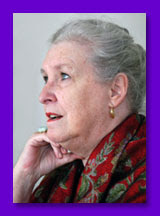
Frances Foster

Where do I begin? Two weeks ago tonight, Barbara O'Connor sent a Facebook message asking for the name of Frances's website. Frances's website? It took a second and I knew. If someone like Frances (in her 80s and probably not blogging) has a website, it's because she's sick with cancer or worse. It wasn't cancer. Frances had a stroke the evening before Thanksgiving, and was taken to St. Luke's.

(flashback:)
Readers, I am lucky in that I've always sought and found refuge with wonderful people in my jobs. At Family Circle, if things were boring reading complaints from readers or if I needed a break for a creative burst, I'd either go to the craft room where Ellie Shrumm was, and sew up a pillow or I'd go to the kitchen to hang with my tiny Czechoslovakian friend Frances Sliwa. At Crown BFYR, my first job in children's books, we had two huge floors of editors. They were fantastic. At this time I worked for Simon Boughton. Nearby were Tracy Gates, Jane Gerver, Anne Schwartz, Janet Schulman, Stephanie Spinner, Kate Klimo, Anne Bobco, Denise Cronin, Isabel Warren-Lynch, Jim Thomas, Mallory Loehr, Melanie Cecka, Karen Hirsch, Becky Terhune, Joan Slattery, Maureen Sullivan, Ruth Catcher, and so many others. 

And there was Frances. 

If I was 23, she must have been around 60-something. Gray hair, blue eyes, long skirts and loose knit sweaters, she was the young, WASPY grandmother-type down the hall who always had time and space and most of all interest--to listen. I could complain, ask questions, or anything I needed. And she shared her stories, too. 

So who was she in the grand scheme of things? Oh, just Phillip Pullman's, Louis Sachar's, Peter Sis's, Suzanne Fisher Staples', and Leo Lionni's editor. You know! Just your average editor. But I tell you something, it wasn't who she edited at all. I mean, yes, those were outrageously fantastic people. But it wasn't about any of them. It was Frances. It was just her calmness, her gaze, her safety. Her love. How could one person have that much to give to some youngster like myself? She did! Who knows if she showed this affection to others. Tell me, everyone! It wasn't just me, was it? Wouldn't it be nice if it was? But I know everyone loved Frances.

When I think of years later when I had my own assistants and interns, I like to think I modeled my own sense of how positive it was for affection to be felt between senior and junior editors--on what I felt from Frances. Anne Schwartz, too, was such an important mentor--fun, feisty, brilliant, always annoyed with something! I truly believe that the two of them were the Yin and Yang of Knopf. (You can't forget how much fun it was to visit Janet Schulman's office, but I grew closer with her later once Frances and Anne had moved on.) Oh, what I'd give to go back for one day to those offices on 201 East 50th Street. Just for the day!

Sorry to ramble. Seeing Frances today brought up so many memories for me. What's more important than my little trip down memory lane is telling friends and loved ones of Frances who have not yet heard much about her, that though she is suffering from the effects of a devastating stroke, she is still completely Frances. She is able to move her left side, including her leg, her arm, and the left side of her face. The heartbreak for her and for us is that right now she cannot speak. She does say a lot with her left hand though. Yes--she held it out to me several times, and allowed me to massage it and put on lotion. When Kate arrived, the hand went right up, and the two of them constantly held on to one another as Kate did her magic--sharing stories with me, being utterly positive, and making her mom feel the love that is so evident between them.

I had been warned on the Lotsa Helping Hands website that Frances cries a lot, and it's true. And thank goodness she does. Crying is a magnificent, expressive way to show feelings of love, frustration, and sadness--all at once. When she recognized me, her beautiful blue eyes crumpled, and her face said everything. It felt like she was saying, "Jill, you came! I'm in here and there's just about nothing I can do to tell you what I want to tell you. So this is it! It's not fair! But I'm glad you came."

Not surprisingly, it was very poignant for me, because I lost my dad suddenly last year, and never had the chance to see him after his fatal episode. I told Frances, "You are alive! You are alive! You made it." We both cried.

But here's the truth: It is very, very hard for her. She's so strong. She has so much she wants to say, and her brain and body aren't ready to let it happen. As I sat in front of her, I realized she hadn't eaten breakfast yet, so I helped her with oatmeal, egg, and apple sauce. She was so feisty. She took each container in her hand, and brought it to her mouth. After a while, I'd ask: Can I use the spoon and help? She would nod yes. There are lots and lots of nods. And she was hungry. Morning, if you're wondering, is a lovely time to visit. I kept wondering if sign language would be useful for stroke victims. Well, of course it would, but  . . . .. (People, learn it now!)

When Frances's beautiful daughter, Kate came about an hour into my visit, I was just starting to feel concerned. I had so many questions and Frances couldn't answer them. I felt I needed help. Was Frances tired? Was my endless chatter going to drive her nuts? Was she uncomfortable in any way?
Had it been inappropriate to read her the first two paragraphs of my novel? I realized that writers can really come in and torture Frances if there's no guard there! I said this to her--I said, "Gosh, maybe it's awful!" The I realized I wasn't pitching Frances my novel. I was just trying to share something of myself with her, something else to think about, besides feeling sad and frustrated. I made her laugh a lot. And at those times, I heard her strong voice in there. I told her: "I hear your voice."

I brought in some tea (she liked a taste) French macaroons (she liked the colors) and tiny madeleines (she agreed they were adorable). She looks intently into the eyes of her friends and loved ones, almost like a baby does. I told her she was definitely the prettiest gal in the place. And the truth is that if you go see her, yes, she's thin, and yes, she's very challenged. But she is improving, and she still looks absolutely as beautiful as always. She doesn't look away in sadness or want pity. She stares right at you, as if any moment she will open her mouth and just say: "I'd love a cup of tea. Would you?"

I hope this happens very, very soon, because no one deserves another chance more than Frances.


Friday, October 19, 2012

The big milestone

Today is the year mark of my dad's death in India. I wrote about it, and shared it with my family and a few friends. I am sharing it below with you.

Over the past weeks, those of us Davises and Pearls who survive him have thought about him and about how we want to acknowledge this milestone. Today we drive to Boston to be with my mom, brother and his family. Eric, me, Gus, and Henry. We'll all eat together, we'll bring a guitar and try to get everyone singing, we'll do whatever my mom feels like. There's no gravestone. No cemetery. She doesn't want the kids to forget him. Little does she know--no one could ever forget him. How could they? She took his jar of ashes and put a Yankees cap on it.

Fall in Massachusetts is so beautiful. It will be impossible not to think about the raking of the leaves, the foliage on Moose Hill Parkway, the decades of my mom's great cooking, and all of our family dinners. If anything was happening in the world, my dad could explain it to us. He just seemed to know everything. Dinner time was when we'd get all our answers. I know how hard it is for my mom to sit through the presidential campaign without him by her side. He had such a uniquely expressive sense of moral outrage.

Going forward, I will write more about the times when he was alive, but for this one year anniversary, I guess I'll share the story of what happened to us that night one year ago. It would be lovely to spend the time remembering my 44 years with him before this day. At the same time, I acknowledge and accept that being with him in the moments I describe below was probably the luckiest thing to happen to both of us. The truth is that I feel honored that I was the one to be with him when he died. And though I miss him every minute, I appreciate that I will never have to see him get old and frail. Though it seems unlikely as I recount the events of that October night in Udaipur, I know watching him grow old would have been even harder. I see my friends going through the long slow torture, and I look up and say to my dad. "You sure did it in style, shnookums."

BE STRONG 
October 19, 2011


“Ambulances don’t come here,” said the voice at the front desk.
My dad lay listless in his bed. It was awful. Around nine he’d gotten up to use the bathroom in our little hotel room, but didn’t return. No sound came from the shower or the toilet, but the light was on. I peaked around into the bathroom door, and there I saw him--laying on the tile floor, ghostly and unconscious.  
We’d arrived in Udaipur, “The Venice of India” that day, tired ourselves out on a tuk-tuk tour, and jumped in our hilarious side-by-side father/daughter beds knowing next to nothing about our environs. It was good we shared a room, after all.
“Dad?” I had prodded him as he lay frozen on his side. Hearing his name, he thawed a bit, and came to. He asked what happened. We got him up and into bed--but he was out of it. He’d hit his head and there was blood. I’ll admit I was really, really scared.
“I need help,” I told the front desk.  “My father’s sick. I need a doctor!”
His next episode happened a few minutes later--like fainting, but worse. “He’ll be fine,” assured a doctor an hour later. “Would you stop asking me about oxygen!” He scolded me for my behavior as he left the Haveli, but nothing could explain his behavior. He didn’t connect or seem to want to.
Thinking back to this time just a year ago—we were both getting ready for our fifteen-hour flight from Newark. We’d had our shots, pills, etc. I wasn’t worried about malaria as much as jet-lag.  My dad only worried about his lesson plans for teaching. When I spotted him at Newark, he wore a smirk like Indiana Jones. His sense of joy was palpable. Mine, I hadn’t yet realized, was compromised by a sense of responsibility I hadn’t felt since I was a brand-new mom. My dad: Beloved professor, staunch humanist, Doo-Wop aficionado, affectionate beyond description, klutz. Me: the one who’d printed out twenty pages of “what-ifs” from the state department knowing I was going to a place I’d only seen in movies with words such as Slums in the title.
So we went, just he and I. My mom stayed in Boston. India was too damn hot.
He’d teach secondary teachers at the American School in Bombay; I’d meet with elementary kids and talk about my writing. We’d have five days there, and then fly north to see beautiful Rajastan. Yet here we were, on the first night of the second leg of our adventure, and something had gone terribly wrong.
When the men with the stretcher finally arrived, I breathed again—I’m not alone. But my confidence crashed when I saw their so-called ambulance. Was I expecting a hospital-in-a-van like in New York City? Maybe so, because this ambulance was an empty van—no oxygen, no EMTs, not even a strap for the patient. Guess we’d just have to rush to the ER.
My dad lay covered in the softest white duvet from our room. I sat by his side, rubbing his arm as we drove, mostly trying to keep the gurney (and him) from rattling up and down. A cow ambled across the narrow road in front of us.  It was like Monty Python here. I looked down, wanting to tell him about the cow. But instead he told me something: “If I wasn’t nauseous before,” he croaked, “I’m nauseous now.” Any other time, I’d have laughed out loud at our absurd situation, our crappy luck. But there was no laughing this time. I’d never felt this alone, this responsible, or this afraid. The bottom was falling out—I felt like a nursing mother who couldn’t produce enough milk—or someone who’d just seen her child fade from sight across a busy intersection.
At the ER, a doctor leisurely measured his oxygen level as others looked on.  “Just get him oxygen!” I was emphatic and panicked.  Didn’t anyone get it?  Anyone? Hello? Next I spotted something on his face--something no one noticed. He looked frozen. His eyes had gone glassy. “Look! Look!” I yelled, “Look!”
Now it was really happening. I was ushered from his side—pushed outside a curtain. But I watched everything—my body floating above, screaming. I was turning inside out. He wasn’t responding at all. I answered my phone. It was my aunt. “My dad’s dying.”
“Go be with him,” she urged. She’d been trying to reach me. “Touch him, tell him he’s not alone.”
I did those things, but he was gone.
Later everyone asked: “How did you hold it together?”  I didn’t. I cried without stopping for the rest of the night. I looked at his suitcase, at his sandals, and waited for something to change. On the phone I told my mom I was all right. I heard my husband cry.
The real job of holding me together came the next day, and it fell upon the men from Amet Haveli, the hotel.  Horrified and concerned, some of them had followed our ambulance the night before, and never left the hospital; another was sent by the hotel owner to help me. Even the waiter from the hotel’s moonlit cafe had stood next to me in the room where my father’s heart had stopped beating. He came over to me in the aftermath, his eyes filled with tears.
The only woman I saw that night was the ER doctor.
The rest were men. Everyone of them used the same two words: “Be strong.”
So I tried.
We knew our dad wished to be cremated, his ashes scattered in Coney Island, so my brother and mom both agreed. We’d respect his wishes. The man sent to help, called Gchouan, offered a traditional Hindu open-air cremation as a funeral. He brought me to see the place. It was just a long slab of concrete with some pyres. The area behind it strewn with garbage. A few filthy Hindu monuments.  Nothing we’d ever see in the US. How long had the place been there? Centuries?
The cremation took place only after a long day of mind-numbing Indian bureaucracy. Another man, Reggie, helped me, too—“our guy in Udaipur” as the gal at the consulate called him. We needed Reggie to help convince the police that I didn’t want an autopsy at the government hospital. Nearly a dozen men discussed the issue for three hours or more. I didn’t care what it took, I didn’t want him cut open in a place that wreaked of dog shit. Besides, after the ER experience at a private hospital, I didn't want to know what this place would be like. Instinct took over and I refused to lose him again. Let his body stay whole.
Finally extricated from the filthy government hospital, his body, wrapped in muslin was slid inside the white painted funeral vehicle’s long cubby. Reggie motioned for me to climb onto the back, and we sat up top on a bench next to my dad as we made our way. Traditional Indian Music played as picture of Ganesh smiled down at us. Remover of Obstacles.
As we drove through the streets, the people of Udaipur heard the sounds of the Indian music. When they saw us, they stopped. The white vehicle with red painted Indian writing, the music, everything signaled a tradition. I was the only one who didn’t know about it. Staring into my eyes to make contact, the beautiful people in their pink kurtas and orange cotton saris, placed their palms together respectfully, and bowed to me and to my dad. Many, many others joined in as we drove. A few gazed past my swollen eyes right into my breaking heart. Riding behind us, like valiant soldiers on horses, were the men from the hotel on their motorcycles. A few hours earlier, I’d wanted to bury myself alive—now, somehow, I felt elated. I felt like a Kennedy child, maybe Caroline. I took pictures as if I’d show them to my dad later. I spoke through my tears, “Dad,” I said, holding onto the flowers that were placed there, “You wouldn’t believe how beautiful this is.”
We arrived as workers sorted wood for stacking on the pyre along the concrete platform. Soon, we carried his body, our poor sweet bundle, to the place it would never leave.
Now he lay cradled on the wood branches. Gchouan was my guide. He told me that soon they would unwrap my father, exposing his face and chest. “Be strong,” I remembered. So I braced myself. From five or six feet back I watched, my eyes half closed just in case I saw something I couldn’t bear. But as the gauzy white was ripped and pulled open, I saw him again. Dad. He looked pink and beautiful. His nose was mushed, but not terribly.
A man opened a box of ghee (liquefied fat, like butter) and then another—pouring both on his body. After flowers had been placed around his neck, I was handed a cluster of twenty or so tiny smoking twigs. “You hold them near him and it symbolizes that you lit the pyre.” They told me that women were only allowed here if they were the dead person’s only relative. They poured water in his mouth after placing a coin inside. That part was bad. Too uncomfortable for him. I didn’t want a coin in my mouth, why would he? Now was my time to touch him. I reached out my fingers and felt his soft gray hair. Maybe this was my way of saying good-bye. As I write, I can’t remember the last time I kissed him.
The pyre was lit, and in some spiritual way, I suppose I was glad for him. Glad he wasn’t cut open at the smelly hospital. Glad he didn’t suffer too much. Glad that even though the country of India had the worst ambulance ever, they knew how to do this part right.  Gathering for a group picture, the dozen men and me, it felt like we’d fought in a war together. My brother was with me, too, thanks to the miracle of modern technology, and I was grateful. He said he’d tell our mom what was happening. I couldn’t bear to think about her pain.
“It was predestined,” these saddened, kind, locals told me afterward, grasping my arm in the place I’d held onto my dad’s the night before. I wish I believed it—I really wanted to. Though I can tell you one thing, my dad wouldn’t have bought that line in a million years.


Wednesday, September 12, 2012

Something So Right

Today I celebrate a new story.  It's the story of me and a new collaborator. She goes by the name of Erin Murphy. You can see her website if you haven't heard of her. Her agency is EMLA. Erin has agreed to represent my children's books. That means she reads my work, helps me understand what's working (and not), then gets me to fix it, eventually creating, as Jack London calls it, "marketable goods." Once those marketable goods are polished and ready, they are sent to editors for consideration.
Erin Murphy

"How I found Erin" is a story I keep going over. It began early this summer when I thought I had a closer draft of my MG novel. With that accomplished, I felt happy, yet completely aimless. Eureka! (I didn't say this out loud) I figured out the problem. I wanted a partner in my writing career. Without someone to bounce my work off of (bad sentence) I was in danger. Danger of opening a fruit stand or becoming a babysitter. Doing anything to make a little money! (I do also teach and a few other things.  Just being dramatic here.)

Back to the story:
So what did I want from this partner, anyway? Think, think, think. I thought about my friends Jessie Hartland and Brenda Bowen. They work together as author/illustrator and agent, respectively. Among other unique book ideas, Jessie had a graphic bio of Julia Child in her head when we worked together in the past (me as editor in my previous life).
Brenda Bowen

Jessie Hartland


After I left publishing, Brenda became Jessie's agent. Brenda submitted the Julia Child graphic biography book dummy to Random House. (Or maybe she sent a query. I'm not sure!) Why Random House, you ask? Here's why--Brenda figured out they were Julia Child's publisher. She knew they already had an enormous investment in Julia Child. And wouldn't a picture book biography be perfect for the French Chef's hundredth birthday! Brenda was exactly right. The book was bought by Anne Schwartz for her imprint Schwartz & Wade. It all made perfect sense. And now it's out. It's called Bon Appetit! And it looks great. (Apologies if any of these facts are wrong, but I think it's all true because I know these people.)


I tell this story often--to writer friends, writing students, and others--because it shows the depth of reflection on the part of an agent. As a former editor, I know authors from the other side. They have enough going on for goodness sakes--they're trying to put the words together on the page. It's not easy! They can't deal with money and personalities and publishing houses! YUCK! Finding a home for a book in its early stages is hard work that requires a polished skill set: diplomacy, patience, shrewd business skills, marketing savvy, luck. But it also requires a huge dose of humanity. It requires LOVE! I don't always have all or any of those things! But I wanted a partner who did.

If you're FB friends with Erin Murphy, and you read her posts--you know that she's that person. She reflects constantly, almost daily. She's cheering for her authors--reporting their good news. And she admits when she's tired or busy or says something like this: "Sometimes my desire to be thorough and methodical with my work is not in line with the world's plans for me."

Mmm. Yup. In the sometimes surface world of cyber socializing, Erin is the real thing. So these past months, as I thought long and hard about who might make the right agent for me,  I wondered: Is it someone who'd make me rich? (Um, yes.) Someone at a big agency? (Not necessarily.) Someone with power? (Perhaps. Why not?) I thought of lots of wonderful agents. I even had a really kind agent--but all the time, there was a thrumming in my belly--where all the emotions live. It said: Erin, Erin, Erin. I didn't always pay attention to it, and then one day I just knew. What I really wanted was none of those things above--I just want someone who loves my work.

So I sent her my work.

When the YES e-mail from Erin (prompted possibly by my ever-so-gentle note explaining that I was being  patient) it was a great moment. (Actually, she didn't say YES! She listed nice and constructive things about my work and simply asked: So what do you think?). What did I think? I thought: Hell ya!

Can you tell I felt an enormous relief? I did. I do. I'm very excited.

(WARNING: ABRUPT TRANSITION)

Not only that, this Erin Murphy moment coincided with the time of my fifteenth wedding anniversary. Because of that,  I was reminded of our wedding song: Something So Right. (Yes, Paul Simon!! But I must admit I first heard Annie Lennox's rendition!)

Well, I won't drag out this story--I'll just say Paul Simon's song was the story of Eric and me, but I think it also had a lot to do with finding Erin. With Eric, it took five complicated years for us to get to the wedding day. It was hard, but thank goodness for that time we spent learning how to be together. Eric taught me the value of waiting--and the risk of rushing into something important. And he showed me. Never told me. I watched him. And I suppose what I learned more than anything is why no one should want another person to do something they don't wish to do. On the other hand, not everyone is lucky enough to be married to a Buddha. But he was a Buddha with his heels dug in deep, so I had my work cut out for me. We had plenty to learn from one another.

At the risk of sharing lyrics without the music, here is the refrain from Something So Right. If you don't know it, it's all over Youtube

http://www.youtube.com/watch?v=3x-SXYRZBYk
My buddha

When something goes wrong
I'm the first to admit it
And the last one to know
When something goes right
Well it's likely to lose me,
It's apt to confuse me
Because it's such an unusual sight
Oh, I can't, I can't get used to something so right
Something so right

Erin, Eric, I'm so glad for both of you. Someone new, someone old.
Two great partners!
Excuse me, I have to go drink my champagne and do some laundry.

Wednesday, April 18, 2012

Six months down and a life time to go

The thing about writing is that you're always looking for a new way to say the same thing. Why is that? It's because over time, our common thoughts turn into ready-to-use phrases. These phrases get used because they're so perfect for a time--and then they get used too much, and eventually become cliche. The cliche loses its strength, sort of like expired medicine or last year's nail polish color. Okay, not exactly, but we simply have to search for fresh ways to use words every day. Don't we?

Reading books translated from foreign languages can help. The French would say "Tu parles Francais comme une vache Espagnol." It translates to "You speak French like a Spanish cow." Not something you'd say to an American with lousy French, I'm sure--but isn't it funny to know their common expression. I guess we'd say, "He sounds like he's just off the boat," or some such. I remember when I lived in France, I once had my haircut by an Italian man. After that I knew how to say, "Now I'm going to cut your hair," in French, but with an Italian accent. That cracked me up. More poignant, I suppose, was the fact that many of the domestics living in France were Portuguese. I learned to recognize that accent (the Portuguese accent in French) as well. Words, words, words. They're the bomb.

Today I woke up knowing that tomorrow marks six months from the day my dad died in Udaipur, that crazy little town in India with the palaces in the middle of the big lake--the "Venice of India." Where the movie Octopussy was shot, they say. The Venice of India is not such a good place to get sick, by the way. So as you can imagine--I cried a lot this morning as I tried to collect memories of that day. We had a great flight, but then the disappointment at arriving at a hotel that seemed dilapidated and depressing, and sort of walled in. There was our ride in the tuktuk that felt more like a refurbished mo-ped from 1976, than something three grownups should be riding around the "Venice of India" in. We finally saw the lake and the palaces we'd read about, and even a camel or two on the side of the road. We stopped at a beautiful garden--an ancient royal garden of some sort. That's where I took the photo of my dad with all the jokers--a group of sophisticated teenage Indian tourists wearing sunglasses. They were just my dad's type. There was an enormous fountain filled up with lily pads, and then we saw a beautiful curvy woman in a yellow sari, and we said that was the Indian version of my mom. He told me his last joke there, and we gave some change to a very poor woman and her toddler.

When Henry woke up at 7:15 this morning, he came in my room. When I told him to look out the window at the shivering tree, that today would be chilly unlike yesterday, he made a "brrr" sound, and climbed into our bed. I looked at his little bronzed face and told him I'd spent the morning crying. I told him that tomorrow was the six month anniversary of Oompah. He looked at me in total sympathy, his eyes welled up, and he smiled. "Oompah was the best joke teller." That's what he said. I can see my dad shaking his head. He just loved Henry.

So my head and my heart were heavy (but open) all morning as I re-wrote a satisfying sibling fight scene in the draft of the book I will someday share, and Eric left with the boys. Yet I couldn't stay in bed with my beautiful new laptop all day (Thanks, MOM!) I had to go out into the world to see the dermatologist. Going out into the world--that's when things happen. Fifty-eighth and Sutton Place may not sound so bad to you, but to us, it may as well be Minneapolis or Timbuktu. I threw the apartment back together, put on a dress that matched my beautiful brown Repetto ballet flats (Thanks, Shela!) and wrapped myself in one of the big hand-woven scarves my dad and I picked out at Harry's, the store in South Bombay where he bought two rugs for my mom. I cracked myself up, saying: "Did you ever get the feeling that the scarf you're wearing is really a table runner?" I imagined him laughing, too. I think it actually might be a table runner. How does one know? Well, I'm always imagining him laughing. Maybe that's when I miss him the most. That's always when I realize how much I miss his voice. He had so many of them (voices) but several of them were just so gentle. For a guy with a raspy voice, he really was able to sound like a pussy cat.
-
So I'd made my way to the Middle-East of Manhattan, and there I was--right at the on-ramp of the Queensboro Bridge. God in heaven! Who wants to cross that? But I guess my old Pop was watching, because as the light turned red for the ramp, I heard a familiar sound. It went something like this" "Sh-boom, Sh-boom. Ya da da da da da DA da da da da Sh-boom Sh-boom." Now, this is not the typical song you hear coming out of a car window in Manhattan. This is a song from around 1954. So I turned my head to the right, to see where on earth it could be coming from--and there sitting in a big old SUV with a giant YANKEES sticker on it, was an old happy fat guy with shiny greased back gray hair, just singing along to the Chords. I looked straight at his face, and he caught my eye. I sang a long for a few bars, and then I gave the guy the old thumbs up. He smiled. And as I walked away, I talked to my Dad--who I guess was trying to tell me he was okay. "Dad," I said to him. "I'm so glad you're doing okay now. Because you weren't so good the last time I saw you."

So I won't go on and on about how weepy I got. (I'm starting to feel like Holden Caulfied, walking around New York observing old people.) But the whole day has been like that. So I'll just try and wrap up with two thoughts. First, I decided that instead of thinking of tomorrow as the six month anniversary of the day we lost you, Dad, I'll think of today as the six month anniversary of the last time you taught, and I'll just say to those students at the American School in Bombay: You guys were really, really lucky.

And I'll finish by making sure Dad, that you know I didn't just sit around and cry all day. Like I said, I went to the dermatologist (something we always did together) and then I went to a thrift shop and bought a pair of really cute shoes for ten bucks and a pair of black silk capris (also $10)--just like the ones Mary Tyler Moore used to wear on the Dick Van Dyke show. (I know you loved her.) Oh yeah, then I bought some yellow Freesia and made a little shrine on the living room table instead of getting one of those depressing candles that Jews use. I know the flowers would probably make you sneeze. Not once, but about sixty five times. So God bless you.

Love you dad. I hope you know how much.

Wednesday, January 25, 2012

One year later: New Bloggage!

I looked at this page for the first time in a year. I am sorry, my dear blog. My fault, I fear. In the 12 months I spent not blogging, I completed a 57-page paper on the idea of QUIRKiness in writing for kids (thanks, Polly Horvath, Nathalie Babbitt, and Anne Ursu) and I completed 116 polished draft pages of my middle-grade novel. I had to give the book a name. The title AGNES VON KLINER, FASHION DESIGNER no longer worked since my MC (main character) changed to Agnes's pal, Carly Blye. The working title (is it working?) is Leave a Message for Carly Blye.

SO, my friends, you ask: The graduate degree is done. You know all there is to know. Now what? Well the answer is simple: No, I don't! I am still not sure how to finish the novel, all of my picture book manuscripts need overhauls, and I've had a sudden revelation about rhythm! (As in, my writing has none!) I want so much to be one of these people with a rule! What rules? Okay here are some examples: Write every day. Write every day for 7 minutes. Write a poem a day. Come up with a schedule and adhere to it! Okay, done. I hereby promise to write every day. NO MATTER WHAT. If I'm lucky, maybe I'll post some of my new-found rhythmic ditties here. Please stay tuned. You may not feel so lucky if you have to read them. Hah!

One the reading front, I recently read something I loved: GOOD GIRLS by Laura Ruby. It's a full-on YA with love, lust, rumors, and pain. It's very smart and not over the top, but thoughtful and important. It had everything a teenage girl wants. It's also a bit of a primer on teen romance if you have a boy who's willing to go there. I wouldn't give it to my kids (10 and 12) for fear they'll just laugh at me. But maybe if I leave it out, my tween will notice it. Nah. He's still re-reading Matilda. Henry and I have slowly been enjoying The Trumpet of the Swan by E.B. While. Oh, the joy of a slow, unraveling simple plot.

On the life front, I lost my dad last year, and it's still so hard to believe. I had school to finish this winter, so I found a way to put my sadness away for a little while in order to focus on writing. But, it's here. It's back. I miss him. I hope to write about him and about my amazing, surviving mom in the near future.

Monday, January 17, 2011

Reading and Writing. Behold!

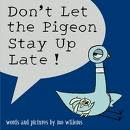
I arrived home today from my writing residency--eleven days in St. Paul, and boy, oh boy was it a crazy, wonderful, kooky, insane, inspiring, emotional (did I say crazy?) week. Well, it was. Indeed. I am happy to be home in NYC, but find myself telling stories no one wants to hear about people they've never met. Do you know how that is? My older son (Gus) is walking around the house exclaiming: BEHOLD! (This exclamation comes from the game Dixit--an awesome game that uses the other side of the brain--courtesy of Kiel Phegley, a first semester writing student.) And Henry (8) who read the new Mo Willems, now feels he has unlocked the secret to successful illustration: "It's the expressions!"

I came home with signed books for them, including Godless by Pete Hautman, The Wednesday Wars by Gary Schmidt--and others not signed, but purchased at The Wild Rumpus Book Store. These include a Moomin picture book, Who Will Comfort Toffle? also a lovely, quirky, sad short novel called Against the Odds, and a stunning picture book called Lola and the Rent-a-Cat. The latter two both about serious subjects: fear of losing a parent in war and then death and loneliness.

This semester I begin work on a critical thesis, so beginning tomorrow, I begin looking for very quirky middle-grade books that address serious topics. I plan to look at how extremely unusual writing and voice allows children to access difficult topics. Should be an emotional tilt-a-whirl. If anyone has any favorites, please tell me. I am going to look at The Pushcart War, an all-time favorite.

At school this residency, we learned about writing for character. The faculty was (were?) fantastic and came up with original and evocative talks. Everything from helping us to think about the meaning of work in our writing and what works when one chooses to anthropomorphize and recognizing your antagonist and how to use subtext in dialogue. This was a lot of the real CRAFT stuff of writing, and because of that--very exciting. ME FEEL SMART!

Before leaving on my trip, my grandmother died. I went off in the shadow of her funeral, and a eulogy I wrote that gave me an opportunity to look at the family's immigrant heritage (the Hochs arrived in 1920 from Kunkalevka, Poland via Antwerp.) While in St. Paul, I thought more than once or twice about writing historical fiction. It seems like it would be so much fun--at least the research.

So now I am home, and what are the boys reading? Henry is finishing the last of the Fudge books. Gus had a choice between a few books, and chose Godless. It's a National Book Award winner about a boy who starts his own religion, and then realizes how hard it is to control. Pete Hautman, the author, spoke to us at school about some of his writing epiphanies. A fun, irreverent, charming and smart speaker, he shared some great ideas. He learned a lot from Elmore Leonard.

One of the highlights was Gary Schmidt's graduation keynote speech (we had four splendid grads who will each have a novel ready to publish soon! Take note, editor friends!) in which he told heartbreaking stories of the kinds of kids he urged our four grads to write for, before anyone else. He always refers to kids as kiddos. Hearing Gary speak or read is something to behold. (Behold!) He wove together his many poignant, funny, delightful stories--stories about Nathaniel Hawthorne's journey from loneliness to marriage; disadvantaged damaged kids he'd reached; the women of Terezin concentration Camp who fought over the correct ingredients for their favorite recipes while they were dying of starvation. He read three scenes to us from his new book, Okay for Now--forthcoming in April. Watch out for it. I can only think of cliches to describe how involved we became with the three scenes he read.

Also spellbinding were our fourth semester critical lectures. We heard about Zen and writing, turning dreams into writing and understanding dreams to better understand yourself, a practical guide to the intrusive narrator (amazing!), and we learned and learned until our brains were stretched like balloons, I tell you!

In my morning workshop, I was Jane'd. That means that Jane Resh Thomas, one of the founders of the program, made an example out of my sloppy lard-ass writing. I found out (the hard way) that I use "filters" which distance my writing from my reader. Who knew? I felt hurt, defensive, and whined like a baby. But I promise you--I will avoid them now. In workshop, when we're up, we listen. No talking until the end of the hour. So if you want to explain something to your fellow writers, you have to wait until the end. I think my jerking body betrayed my attempt to appear unhurt. But it hurts. And I know how much I have yet to learn. And yet, yet, YET--every reader reacts differently. If that weren't true, we'd all read the same book. I only recently found out that those Dragon Tattoo books have violent sex scenes in them. No wonder they're so popular. Jeepers. Who knew?

Back to life. I have to go give the boys their good dreams and maybe read them a story. More to come--and I hope to add some books jackets and pictures to match this.

Oh yeah. I can't sign off without publicly thanking my dear friend and pal-o-the-month, Peter Pearson. He was a dear friend to all of us at the residency. I think he has a heart four sizes too large. But to me especially. He played his guitar while we sang an adorable song my lil Henry wrote about a book he'd read a few months ago. The song was for a school project. The book was Because of Winn Dixie, and we performed a funny interpretation of it at the graduation banquet. Little did we know that the author of the book, Kate DiCamillo would be sitting directly in front of us. It was a hit. We laughed. We were really happy. I think this happy feeling will last at least until tomorrow. I hope so.

Monday, December 6, 2010

Five months off

People, I took five months off blogging. I think it was because I was writing the
guts of my novel. Yes, you heard correctly, my novel--directed at the very sophisticated audience of 10 year old girls. If all goes as planned, the book will have suspense, excitement, fashion, witty banter, love, loss, and what everybody wore.

As a matter of fact, I had to change the title. It was originally called Agnes Von Kliner, Fashion Designer. But Agnes is now the best friend. The protagonist is Carly Blye. I would hate to be someone who has to run a title contest, but I promise you, dear readers, that not one decent title for this book have I thought of. NOT ONE.

Enough about me and my writing (though I am also working on a book I sold called Carry It, Harriet) enough about my life (I go back to school in a few weeks you know!) how could I possibly go on and on , with complete disregard for the tediousness of the self-referential blogger (aren't we all?)

Anyway, there has been a shift for me in this blog. I find myself seldom reading to my children anymore. Why is this? I am frightened to ask. It's probably neglect. Gus (11) reads about a novel a day, if he has a new one, and Henry (8) vigilantly reads 20 minutes per night for his third-grade reading log. He has read some C.S. Lewis, Garfield, Fudge books by Judy Blume, a great book called Weird Stuff--and more. Gus just finished Rick Riordan's new book in a day. Yup, he brags. And he's lined up some Anthony Horowitz and Susan Cooper.

So I won't say to much about what they're reading until I start paying very close attention again--but I will say that I have continued to read for school (my MFA in writing for Children and Young Adults at Hamline)and I have read Saffy's Angel (loved) Absolutely, Positively Not Gay (an important book), Somebody (suspenseful quick read), The Higher Power of Lucky (misplaced it 3/4 way through, so very upset)and a galley of Betsy Partridge's wonderful new novel Dog-Tag Summer (luscious) and I am also reading Darkness Over Denmark by my friend Ellen Levine who was just diagnosed with Stage 4 lung Cancer, which is so very devastating. She is so loved by so many. She is my Jewish mother in the city, and I already miss her as she struggles with treatments.

Signing off to go pick up kids, but I have not disappeared--I just needed to write a draft of a novel, and so I almost have one. I'd say another 30-40 pages, and I'll have something you can read!

Saturday, July 24, 2010

Comfort in familiarity

Yesterday was a "getting the car fixed in New Jersey" day. Gus had nothing to read (finished Anne Ursu's Siren Song in two days), the hood of the car needed a new part, and so we were both understandably panicked. I'd been thinking about giving Gus some teen fiction, though he's not yet 11. This, because he's suddenly in that in-between age where he can enjoy a picture book or an Eyewitness book (about Knights in this case)as well as a juicy novel--fantasy or realistic. From my shelf I plucked a young adult novel called "Two Parties, One Tux, and a Very Short Film about The Grapes of Wrath" by Steven Goldman. I had edited the book at Bloomsbury just before I left, and loved it so much. It's a terrifically funny book about a boy named Mitchell, whose best friend, David, realizes he's gay--and despite everything they discover together about life and themselves, they remain close. And, of course, they have a typically disastrous prom--involving horrible yellow stains on white tuxedo pants. You guessed it.

Gus had devoured it by the end of the day when the car was fixed ($1300), and I loved asking him what part he was reading every hour or so--so I could reminisce about what a charming book it had been for me to work on. Thinking about it, I realize "Two Parties" was a great book for boys who are beginning to see the fun and humor about more grown-up issues, but who also feel the fears that come with becoming teens.

I learned at Hamline last week--thanks to Chris Campbell's critical thesis--that for boys, fear plays an enormous role in growing into a teen. Sure, 'tween and teenage boys may be curious about girls, socializing, and their own changing bodies, but honestly! The big problem is more about being seen naked in the boys' locker room (Thanks for the image, Chris!) and not feeling humiliated about a squeaking voice, the way you smell, or being over or under-weight. I think Judy Blume had it right when she said: Then Again, Maybe I Won't. These days when I ask Gus if he's excited about something, his answer is usually: "Not specifically." I chuckle, but I realize how indifferent he feels. And why? Because the things an eleven year old wants are the not the things we parents think are "good" for them. Ever. He wants to play video games, talk about whatever matters to him, be sarcastic, read great books, and basically never HAVE to do anything he doesn't want to do. I imagine there are many other things he does want to do, but those probably aren't the things you tell your mom! This topic has become a big theme for me lately as I try an navigate this new phase along with my growing-up son.

Tonight I walked into his room to find him reading yet another book. "I know, I've read it sixteen times," he said as he showed me the cover of Otherwise Known as Shelia the Great. See what I mean? I always feel caught between two worlds, and now he's feeling it, too. It always goes back to Judy Blume, doesn't it!

Now I must go begin revise fifty pages from the novel I am trying (very slowly) to write, but I invite you, my friends, to suggest any great books or films for boys of this age. It's a question that's been stumping everyone in my MFA program. I will say this: Now that I realize that there are big fears and apprehensions that accompany the new-found curiosity and need for exploration, at least I can turn to books such as Fat Kid Rules the World and others, where kids Gus's age are facing the feelings that come with this nerve-racking time in a child's life: he knows he is really starting to grow up for good, and there's nothing he can do to make it go faster or to stop it from happening.

Tuesday, June 15, 2010

Summer Reading, New Books

My new book was released last week and we celebrated with PS 87 by having a reading and book fair to raise money for the school. Peter Ackerman had already arranged to read his new book, The Lonely Phone Booth, and he kindly allowed me to share the stage. His book is hilarious and terribly clever.
My book is called Orangutans Are Ticklish: Fun Facts from An Animal Photographer--and it's really a beautiful book. The photographer is Steve Grubman, who takes studio shots of every animal imaginable. The book features his photos, and my job was to find facts to go with the photos. I learned so much about the most common animals in this process, and now I can actually walk around town discussing where various species of elephant come from and the fact that a tiger would beat a lion in a fight. The book is available anywhere, so if you buy it, I will be happy to sign it for you.

I have been wanting to start a good list for summer reading. Almost everyday, I am asked about this topic. What can my son read? What would my daughter like? I love to do this and yet it's not always easy to come up with an answer on the spot. One of my favorite ways to find the right book for a child is to pull something off the shelf and read the first line, or the first paragraph, or if you can do it--the first page. This has been my secret reading weapon with my older son. I pretend I am going to read him a novel, and after one chapter, I say I am going to bed and we'll continue tomorrow--but then --HA! I trick him and he takes the book and keeps reading!

Here are some perfectly brilliant books for the nine or ten year old! (Most of these authors also write for younger kids, too, so check out their Amazon pages!)

Realistic Fiction:

Swindled and Zoo Break by Gordon Korman
Born to Rock by Gordon Korman
Schooled by Gordon Korman

With a very slightly historical bent:

Al Capone Does My Shirts
and Al Capone Shines My Shoes by Jennifer Choldenko

With a British bent:

Skellig and Kit's Wilderness by David Almond

With superpowers and the internet:
A series in two forms: Hero.com and Villain.net by Andy Briggs

More for Girls:

Eleven, Twelve, and Thirteen (three separate titles) by Lauren Myracle. She also has a series with titles such as TTYL

Sarah Dessen's books are sort of the Judy Blume books of today--friendship, family, romance...fun!

I will be back soon with lists for the younger ages--7-10!

Thursday, May 20, 2010

beautiful art and storytelling

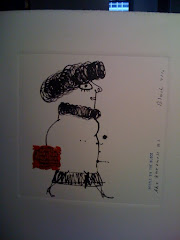
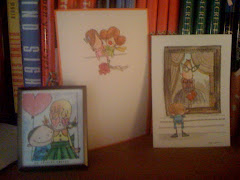
Yesterday I journeyed to Canal street in dirty damp the rain to preview an art show by my friend Serge Bloch. The gallery is Living With Art. 153 Lafayette. The opening is Thursday evening, and the prices are human. Anyone who has been to my apartment knows that I have been collecting Serge's work, but this is the first original piece for me. My friend Vincent Kirsch came, too. Vincent, being the other astonishingly gifted illustrator for whom I keep a shrine in my apartment, helped me pick out a piece called The Baroness. She is reminiscent of William Steig. (I digress to mention there is a show of Jewish picture book illustrators coming to the Eric Carle Museum/Amherst in October! It includes, Serge, Steig, Mordicai Gerstein and the wonderful Simms Taback.)I will pick the Baroness up next week. I will have to ask her where she wants to go. Clearly it's her decision. Just look at her!

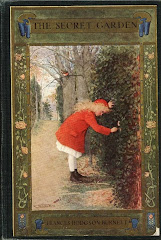
I wanted to write about the love affair I experienced a month or so ago when I read The Secret Garden, but I can't because I have moved on to books about boys. But I can recommend that if you haven't read The Secret Garden, you should do it right now. Promise?

I re-read The Giver by Lois Lowry. I read it along with my fifth grader, and we chatted periodically. The book is about a boy who is chosen in his bizarre Utopian community to receive all of the memories from a man called the Receiver. What moved me about the book were the descriptions of experiences the boy has never known. Makes you think. The one that choked me up was the description of Christmas. Maybe because the scene involved grandparents. The boy in the book has never heard of grandparents, but he feels connected to the idea of it. Good for fifth grade and up.

Maniac Magee by Jerry Spinelli surprised me. Being a book about a tough homeless orphan who runs around between and black neighborhood and a while neighborhood and belongs to both and neither, it really made me think about kids today and how it all looks to them. Told as a tall tale, Maniac Magee feels more like a superhero than a regular child. A very clever concept and story. Good for 4th grade and up.

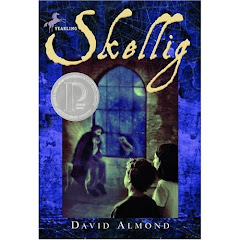
The big winner this month was Skellig by David Almond. This book crosses age ranges. I might read this to my second grader, while handing a copy to my fifth grader to read to himself. (He did, by the way.)David Almond is a favorite writer of Betsy Partridge. Betsy is the third person to whom I have a shrine in my home, but her shrine is photographic. Her new book Marching For Freedom is the story of the kids who marched during the Civil Rights Movement. This is the type of deeply affecting book you can read to your children, and feel you've done your job as a parent for the whole week. Go Betsy! Back to Skellig. I won't say too much about Skellig except for that it's the story of a boy and his baby sister, whose health is bad. His family moves house (yes, it's British) and Michael finds a man or something in the garage. He also meets up with a neighbor girl named Mina, sort of a sassy superego, and of course home-schooled. The little things and big things that happen to them and change them are magic.

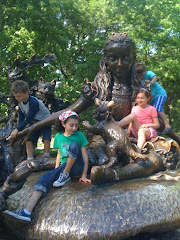
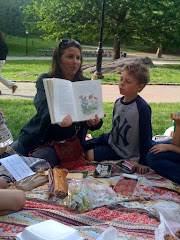
Today is Lewis Carroll Day. Two weeks ago, our second grade book club took a retreat to Central Park where the children climbed on the Alice in Wonderland Statue. We had scones and sandwiches, and read parts of Alice in Wonderland out loud. It was a moment. And it was not raining! On the way back, we met some men who were making bubbles with giant nets. The perfect ending to the picnic.

Wednesday, March 3, 2010

MIA BLOGGER

This is the first time I have ever sat down to write--with little or no sense of what I want to say. I just read my friend's Varda's blog. With twins and a dying father, she is very relatable to most of us, she writes like a poet, and she has a voice that thrums. Her blog is The Squashed Bologna, and I am following it. You should, too.

This blog is about what I read to my kids, but now it's also about what I read to myself. As I pursue my MFA in writing for children and young adults, I must read a list of 120 books supplied by Hamline. This month, I re-read Are You There Gd, It's Me, Margaret for the first time since I was twelve. I read Charlotte's Web and Watsons Go to Birmingham, 1963.

This type of book is referred to as "middle-grade." My definition of a classic middle grade is that it's basically a long chapter book that's not old enough to feature romance or cursing. Middle grades are the wonderful clean read-alouds that your teacher read to you in fourth grade. This is the age level I am trying to write for, too, though I have had several false starts and am beginning to wonder if I'll ever actually write anything.

Aside from my new-found enthusiasm and complete adoration of middle-grade novels, I have also fallen hard for books that teach writing. I read From Where You Dream by Robert Olen Butler and am working at this moment with Donald Maas's Writing the Break-out Novel Workbook. If only there were an online version so you could fill in the workbook again and again!

I wonder if I love these books so much because they have so many great practical tips I'd have loved during my years as an editor. I find myself wanting to call my friends who are still editors and say: "Having trouble with a novel? Try this!" Or I'd tell them: "Don't sweat it, just give the author this workbook! Let them do the work, not you!"

I realize that some of these books may be formulaic or pat or whatever you wish to call them, but they teach the nuts and bolts. Writing is a craft in many ways, and while no one can put the thoughts in your head, a good teacher can explain some of the most important rules. So these days, I find myself in a state of ecstasy several times a day as I come upon ideas on how to develop characters with more depth and internal conflict or even how to use index cards to put a novel together. I love it!

A note on Judy Blume: if you have a middle grade kid who is confused about religion, Are You There God, It's Me, Margaret is your book. What a genius Judy Blume was--to create a character with grandparents of different religions, both battling for her soul. Yes, we always knew it was the "period" book, but as an adult I was touched much more by the idea that poor Margaret goes to synagogue and church in search of religion--completely ignoring the inner knowledge that she already has her own unique relationship with God. Maybe she doesn't realize it, but you can bet the reader does. The book truly stands up all these years later.

Similarly with Charlotte's Web: E.B. White pulls a fast one, letting his reader worry that poor Wilbur is going to be murdered for bacon, when all along he knows that it's Charlotte and not Wilbur who we will soon lose. Charlotte does die at the end, and the only reason I must mention it is that if you don't remember the last line of the book, I will include it here. It is simply stunning: "It is not often someone comes along that's a true friend and good writer. Charlotte was both."

Thank you, E.B. White.

Thursday, January 28, 2010

A New Chapter

In January I went away to school to learn
how to write. It all happened when I was
about to apply for the MFA in writing at
The New School, and a writer and good friend
named Ellen told me to apply to a program
at a school in St. Paul Minnesota called Hamline.
That way, it sort of fell from the sky and landed
in my lap, and for December, I got my application together,
got accepted (a nice feeling!)and on January 7th,
I packed hundreds of fleece layers, my new Sorels, and left
for this place called St. Paul. (Home to both
Scott Fitzgerald and Garrison Keillor)

The program takes two years to complete and involves
going to St. Paul five times, all in Januaries and Julys.
Each residency has a theme--this time it was setting.

The faculty consists of seasoned children's book authors who have
been teaching writing over the years, and it was hard
not to be very impressed by the program--which is run
by a group of logistical savants. In my next life, I
will organize an MFA residency and will be rewarded handsomely!
In other words, it's a lot of planning, logistics, therapy,
question-answering, etc.

The fun part is that I got to go to workshop in
the mornings, lectures in the afternoons, and readings in the
evenings. By day four, I began to feel my brain
stretching like a balloon. I was learning how to stop acting
like an editor and start acting like a writer. (That means being less
bossy and acting like less of a know-it-all and just trying to help one another improve our writing.)

Children's book luminaries came and gave talks (Wendy Lamb,
Anita Silvey, Roger Sutton, Jane Yolen), writing exercises were sprinkled
throughout the lectures, and I met person after person who came to
the program with different life stories and crazy, incredible stories
to share.

To show you who some of the faculty are--all women this time--
I am posting their pictures in the margin. I wish I had copies of all of their books, but some day I will! Each one of them was dedicated, luminous, and
open to the silly first semester students--and for someone who never
really felt the need to connect with professors in college, with these women
I felt like I was being given a second chance!

There were two Marshas, a Claire, a Kelly, a Lisa, a Mary, a Liza, an Alexandria, a Phyllis, a Jane, a Jackie, and an Anne. I hear that in the summer, this is a Ron and a Gary.

I left the residency 11 days later after meetings with
my adorable semester adviser, Marsha Wilson Challs. So now my job
is to read and write. A lot. Marsha suggested a book I have fallen hard for.
The Art and Craft of Storytelling by Nancy Lamb. If you are trying to write, get this book! I am calling it my bible.

Friends and family asked how Eric coped while I was away, and
I think he did really well. The boys seemed to thrive and survive,
and know I missed them more than they missed me. I cried about ten times more than any of them did!

I go back in July--when the snow will be gone. The theme will be theme, and by then I will feel like
a Hamline veteran.

My reading list for the program has 120 books on it, and although I have
read several already, I will refer to them as I read them, and give
suggestions--but first I wanted to tell you about my new adventure!

Sunday, December 13, 2009

The reluctant blogger

It's been a long, long, long time. (The Beatles said this. What did the Beatles NOT say?) Well, it has been too long. I apologize, dear readers. Why do I resist?

I meant to share the experience I had at the Hunter Elementary School book fair lecture. Sean Qualls and Carin Berger came in, both picture book illustrators, and both so talented. They showed pictures/slides of themselves as children and talked about their influences. Carin came from a designer background. She does collage. She showed us the first book she wrote when she was little and then we saw her work and realized how little many of her concepts had changed. Sean Qualls was terrific. He explained how he ran out of money during art school and had to quit--taking a full-time job at the Brooklyn museum, where he first learned about off-beat artistic folks like Ben Shahn, Romare Beardon, Jacob Lawrence--and other self taught artists.
He is married to the illustrator Selina Alko.
I will post their book jackets here soon.

I have discovered a few Hanukkah books and some nice Christmas books, as well.
The Runaway Dreidel by Leslea Newman and Moishe's Miracle by Laura Krauss Melmed both looked hip and current with gorgeous illustrations. I also ordered Mrs. Greenberg's Hanukkah by Linda Glasser. I will report back with reviews. My all-time favorite is When Mindy Saved Hanukkah by Barbara McClintock. You will love this book.

Two more books I found on several sites and heard folks talking about are: a reissue of the 1959 picture book The Blueberry Pie Elf by Jane Thayer. This is so adorable and the look will remind you of Garth Williams.

Another book being talked about is by Eden Ross Lipson, who recently passed away. She was in charge of the children's section at the NYT Book Review. She finished a book before she died called Applesauce Season, illustrated by the great Mordecai Gerstein. The woman in charge of Henry's afterschool program told me about the book with tears in her eyes. That's how much she adored it!

These days, in order to get Henry to read I have to literally shut of the television and say: "It's time to read." Tonight we read a translation of a French book--a Stepping Stone easy-to-read called The Ink Drinker by Eric Sanvoisin, illustrated by Martin Maatje. It was the story of a boy who hates books, but whose dad owns a book store. He notices a client drinking the ink out of books one day, and goes off to solve the mystery of why. Henry liked it, but it wasn't the most satisfying experience, I am sad to report. But it's a great introduction to creepier books meant for older kids! The cover really got me, and the art is pretty spectacular!

For the first night of Hanukkah, Gus got ABC-3D--also an import from France by Marion Bataille. If you haven't seen this video on youtube, it's very quaint and lots of fun.
But the next night he got The Book of Totally Irresponsible Science Experiments by Sean Connolly. He loved it!

He is finishing up a chess tournament, and when he comes home, I hope we can do some of the experiments...

Happy Holidays, and I will be back soon to post book jackets to go with this post.