
My new book was released last week and we celebrated with PS 87 by having a reading and book fair to raise money for the school. Peter Ackerman had already arranged to read his new book, The Lonely Phone Booth, and he kindly allowed me to share the stage. His book is hilarious and terribly clever.
My book is called Orangutans Are Ticklish: Fun Facts from An Animal Photographer--and it's really a beautiful book. The photographer is Steve Grubman, who takes studio shots of every animal imaginable. The book features his photos, and my job was to find facts to go with the photos. I learned so much about the most common animals in this process, and now I can actually walk around town discussing where various species of elephant come from and the fact that a tiger would beat a lion in a fight. The book is available anywhere, so if you buy it, I will be happy to sign it for you.
I have been wanting to start a good list for summer reading. Almost everyday, I am asked about this topic. What can my son read? What would my daughter like? I love to do this and yet it's not always easy to come up with an answer on the spot. One of my favorite ways to find the right book for a child is to pull something off the shelf and read the first line, or the first paragraph, or if you can do it--the first page. This has been my secret reading weapon with my older son. I pretend I am going to read him a novel, and after one chapter, I say I am going to bed and we'll continue tomorrow--but then --HA! I trick him and he takes the book and keeps reading!
Here are some perfectly brilliant books for the nine or ten year old! (Most of these authors also write for younger kids, too, so check out their Amazon pages!)
Realistic Fiction:
Swindled and Zoo Break by Gordon Korman
Born to Rock by Gordon Korman
Schooled by Gordon Korman
With a very slightly historical bent:
Al Capone Does My Shirts and Al Capone Shines My Shoes by Jennifer Choldenko
With a British bent:
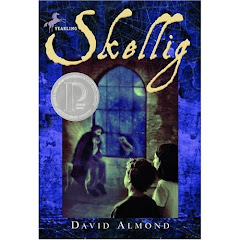
Skellig and Kit's Wilderness by David Almond
With superpowers and the internet:
A series in two forms: Hero.com and Villain.net by Andy Briggs
More for Girls:
Eleven, Twelve, and Thirteen (three separate titles) by Lauren Myracle. She also has a series with titles such as TTYL
Sarah Dessen's books are sort of the Judy Blume books of today--friendship, family, romance...fun!
I will be back soon with lists for the younger ages--7-10!
Tuesday, June 15, 2010


Thursday, May 20, 2010
beautiful art and storytelling
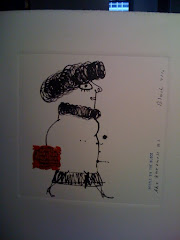
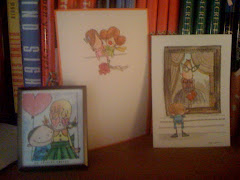
Yesterday I journeyed to Canal street in dirty damp the rain to preview an art show by my friend Serge Bloch. The gallery is Living With Art. 153 Lafayette. The opening is Thursday evening, and the prices are human. Anyone who has been to my apartment knows that I have been collecting Serge's work, but this is the first original piece for me. My friend Vincent Kirsch came, too. Vincent, being the other astonishingly gifted illustrator for whom I keep a shrine in my apartment, helped me pick out a piece called The Baroness. She is reminiscent of William Steig. (I digress to mention there is a show of Jewish picture book illustrators coming to the Eric Carle Museum/Amherst in October! It includes, Serge, Steig, Mordicai Gerstein and the wonderful Simms Taback.)I will pick the Baroness up next week. I will have to ask her where she wants to go. Clearly it's her decision. Just look at her!
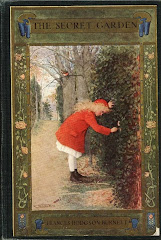
I wanted to write about the love affair I experienced a month or so ago when I read The Secret Garden, but I can't because I have moved on to books about boys. But I can recommend that if you haven't read The Secret Garden, you should do it right now. Promise?
I re-read The Giver by Lois Lowry. I read it along with my fifth grader, and we chatted periodically. The book is about a boy who is chosen in his bizarre Utopian community to receive all of the memories from a man called the Receiver. What moved me about the book were the descriptions of experiences the boy has never known. Makes you think. The one that choked me up was the description of Christmas. Maybe because the scene involved grandparents. The boy in the book has never heard of grandparents, but he feels connected to the idea of it. Good for fifth grade and up.
Maniac Magee by Jerry Spinelli surprised me. Being a book about a tough homeless orphan who runs around between and black neighborhood and a while neighborhood and belongs to both and neither, it really made me think about kids today and how it all looks to them. Told as a tall tale, Maniac Magee feels more like a superhero than a regular child. A very clever concept and story. Good for 4th grade and up.
The big winner this month was Skellig by David Almond. This book crosses age ranges. I might read this to my second grader, while handing a copy to my fifth grader to read to himself. (He did, by the way.)David Almond is a favorite writer of Betsy Partridge. Betsy is the third person to whom I have a shrine in my home, but her shrine is photographic. Her new book Marching For Freedom is the story of the kids who marched during the Civil Rights Movement. This is the type of deeply affecting book you can read to your children, and feel you've done your job as a parent for the whole week. Go Betsy! Back to Skellig. I won't say too much about Skellig except for that it's the story of a boy and his baby sister, whose health is bad. His family moves house (yes, it's British) and Michael finds a man or something in the garage. He also meets up with a neighbor girl named Mina, sort of a sassy superego, and of course home-schooled. The little things and big things that happen to them and change them are magic.
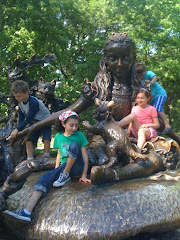
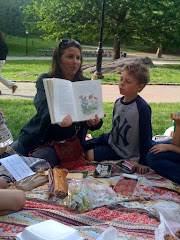
Today is Lewis Carroll Day. Two weeks ago, our second grade book club took a retreat to Central Park where the children climbed on the Alice in Wonderland Statue. We had scones and sandwiches, and read parts of Alice in Wonderland out loud. It was a moment. And it was not raining! On the way back, we met some men who were making bubbles with giant nets. The perfect ending to the picnic.
I wanted to write about the love affair I experienced a month or so ago when I read The Secret Garden, but I can't because I have moved on to books about boys. But I can recommend that if you haven't read The Secret Garden, you should do it right now. Promise?
I re-read The Giver by Lois Lowry. I read it along with my fifth grader, and we chatted periodically. The book is about a boy who is chosen in his bizarre Utopian community to receive all of the memories from a man called the Receiver. What moved me about the book were the descriptions of experiences the boy has never known. Makes you think. The one that choked me up was the description of Christmas. Maybe because the scene involved grandparents. The boy in the book has never heard of grandparents, but he feels connected to the idea of it. Good for fifth grade and up.
Maniac Magee by Jerry Spinelli surprised me. Being a book about a tough homeless orphan who runs around between and black neighborhood and a while neighborhood and belongs to both and neither, it really made me think about kids today and how it all looks to them. Told as a tall tale, Maniac Magee feels more like a superhero than a regular child. A very clever concept and story. Good for 4th grade and up.
The big winner this month was Skellig by David Almond. This book crosses age ranges. I might read this to my second grader, while handing a copy to my fifth grader to read to himself. (He did, by the way.)David Almond is a favorite writer of Betsy Partridge. Betsy is the third person to whom I have a shrine in my home, but her shrine is photographic. Her new book Marching For Freedom is the story of the kids who marched during the Civil Rights Movement. This is the type of deeply affecting book you can read to your children, and feel you've done your job as a parent for the whole week. Go Betsy! Back to Skellig. I won't say too much about Skellig except for that it's the story of a boy and his baby sister, whose health is bad. His family moves house (yes, it's British) and Michael finds a man or something in the garage. He also meets up with a neighbor girl named Mina, sort of a sassy superego, and of course home-schooled. The little things and big things that happen to them and change them are magic.
Today is Lewis Carroll Day. Two weeks ago, our second grade book club took a retreat to Central Park where the children climbed on the Alice in Wonderland Statue. We had scones and sandwiches, and read parts of Alice in Wonderland out loud. It was a moment. And it was not raining! On the way back, we met some men who were making bubbles with giant nets. The perfect ending to the picnic.
Wednesday, March 3, 2010
MIA BLOGGER
This is the first time I have ever sat down to write--with little or no sense of what I want to say. I just read my friend's Varda's blog. With twins and a dying father, she is very relatable to most of us, she writes like a poet, and she has a voice that thrums. Her blog is The Squashed Bologna, and I am following it. You should, too.
This blog is about what I read to my kids, but now it's also about what I read to myself. As I pursue my MFA in writing for children and young adults, I must read a list of 120 books supplied by Hamline. This month, I re-read Are You There Gd, It's Me, Margaret for the first time since I was twelve. I read Charlotte's Web and Watsons Go to Birmingham, 1963.
This type of book is referred to as "middle-grade." My definition of a classic middle grade is that it's basically a long chapter book that's not old enough to feature romance or cursing. Middle grades are the wonderful clean read-alouds that your teacher read to you in fourth grade. This is the age level I am trying to write for, too, though I have had several false starts and am beginning to wonder if I'll ever actually write anything.
Aside from my new-found enthusiasm and complete adoration of middle-grade novels, I have also fallen hard for books that teach writing. I read From Where You Dream by Robert Olen Butler and am working at this moment with Donald Maas's Writing the Break-out Novel Workbook. If only there were an online version so you could fill in the workbook again and again!
I wonder if I love these books so much because they have so many great practical tips I'd have loved during my years as an editor. I find myself wanting to call my friends who are still editors and say: "Having trouble with a novel? Try this!" Or I'd tell them: "Don't sweat it, just give the author this workbook! Let them do the work, not you!"
I realize that some of these books may be formulaic or pat or whatever you wish to call them, but they teach the nuts and bolts. Writing is a craft in many ways, and while no one can put the thoughts in your head, a good teacher can explain some of the most important rules. So these days, I find myself in a state of ecstasy several times a day as I come upon ideas on how to develop characters with more depth and internal conflict or even how to use index cards to put a novel together. I love it!
A note on Judy Blume: if you have a middle grade kid who is confused about religion, Are You There God, It's Me, Margaret is your book. What a genius Judy Blume was--to create a character with grandparents of different religions, both battling for her soul. Yes, we always knew it was the "period" book, but as an adult I was touched much more by the idea that poor Margaret goes to synagogue and church in search of religion--completely ignoring the inner knowledge that she already has her own unique relationship with God. Maybe she doesn't realize it, but you can bet the reader does. The book truly stands up all these years later.
Similarly with Charlotte's Web: E.B. White pulls a fast one, letting his reader worry that poor Wilbur is going to be murdered for bacon, when all along he knows that it's Charlotte and not Wilbur who we will soon lose. Charlotte does die at the end, and the only reason I must mention it is that if you don't remember the last line of the book, I will include it here. It is simply stunning: "It is not often someone comes along that's a true friend and good writer. Charlotte was both."
Thank you, E.B. White.
This blog is about what I read to my kids, but now it's also about what I read to myself. As I pursue my MFA in writing for children and young adults, I must read a list of 120 books supplied by Hamline. This month, I re-read Are You There Gd, It's Me, Margaret for the first time since I was twelve. I read Charlotte's Web and Watsons Go to Birmingham, 1963.
This type of book is referred to as "middle-grade." My definition of a classic middle grade is that it's basically a long chapter book that's not old enough to feature romance or cursing. Middle grades are the wonderful clean read-alouds that your teacher read to you in fourth grade. This is the age level I am trying to write for, too, though I have had several false starts and am beginning to wonder if I'll ever actually write anything.
Aside from my new-found enthusiasm and complete adoration of middle-grade novels, I have also fallen hard for books that teach writing. I read From Where You Dream by Robert Olen Butler and am working at this moment with Donald Maas's Writing the Break-out Novel Workbook. If only there were an online version so you could fill in the workbook again and again!
I wonder if I love these books so much because they have so many great practical tips I'd have loved during my years as an editor. I find myself wanting to call my friends who are still editors and say: "Having trouble with a novel? Try this!" Or I'd tell them: "Don't sweat it, just give the author this workbook! Let them do the work, not you!"
I realize that some of these books may be formulaic or pat or whatever you wish to call them, but they teach the nuts and bolts. Writing is a craft in many ways, and while no one can put the thoughts in your head, a good teacher can explain some of the most important rules. So these days, I find myself in a state of ecstasy several times a day as I come upon ideas on how to develop characters with more depth and internal conflict or even how to use index cards to put a novel together. I love it!
A note on Judy Blume: if you have a middle grade kid who is confused about religion, Are You There God, It's Me, Margaret is your book. What a genius Judy Blume was--to create a character with grandparents of different religions, both battling for her soul. Yes, we always knew it was the "period" book, but as an adult I was touched much more by the idea that poor Margaret goes to synagogue and church in search of religion--completely ignoring the inner knowledge that she already has her own unique relationship with God. Maybe she doesn't realize it, but you can bet the reader does. The book truly stands up all these years later.
Similarly with Charlotte's Web: E.B. White pulls a fast one, letting his reader worry that poor Wilbur is going to be murdered for bacon, when all along he knows that it's Charlotte and not Wilbur who we will soon lose. Charlotte does die at the end, and the only reason I must mention it is that if you don't remember the last line of the book, I will include it here. It is simply stunning: "It is not often someone comes along that's a true friend and good writer. Charlotte was both."
Thank you, E.B. White.
Thursday, January 28, 2010
A New Chapter
In January I went away to school to learn
how to write. It all happened when I was
about to apply for the MFA in writing at
The New School, and a writer and good friend
named Ellen told me to apply to a program
at a school in St. Paul Minnesota called Hamline.
That way, it sort of fell from the sky and landed
in my lap, and for December, I got my application together,
got accepted (a nice feeling!)and on January 7th,
I packed hundreds of fleece layers, my new Sorels, and left
for this place called St. Paul. (Home to both
Scott Fitzgerald and Garrison Keillor)
The program takes two years to complete and involves
going to St. Paul five times, all in Januaries and Julys.
Each residency has a theme--this time it was setting.
The faculty consists of seasoned children's book authors who have
been teaching writing over the years, and it was hard
not to be very impressed by the program--which is run
by a group of logistical savants. In my next life, I
will organize an MFA residency and will be rewarded handsomely!
In other words, it's a lot of planning, logistics, therapy,
question-answering, etc.
The fun part is that I got to go to workshop in
the mornings, lectures in the afternoons, and readings in the
evenings. By day four, I began to feel my brain
stretching like a balloon. I was learning how to stop acting
like an editor and start acting like a writer. (That means being less
bossy and acting like less of a know-it-all and just trying to help one another improve our writing.)
Children's book luminaries came and gave talks (Wendy Lamb,
Anita Silvey, Roger Sutton, Jane Yolen), writing exercises were sprinkled
throughout the lectures, and I met person after person who came to
the program with different life stories and crazy, incredible stories
to share.
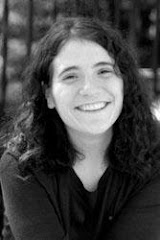
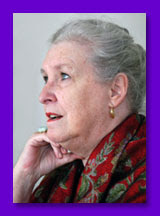
To show you who some of the faculty are--all women this time--
I am posting their pictures in the margin. I wish I had copies of all of their books, but some day I will! Each one of them was dedicated, luminous, and
open to the silly first semester students--and for someone who never
really felt the need to connect with professors in college, with these women
I felt like I was being given a second chance!
There were two Marshas, a Claire, a Kelly, a Lisa, a Mary, a Liza, an Alexandria, a Phyllis, a Jane, a Jackie, and an Anne. I hear that in the summer, this is a Ron and a Gary.
I left the residency 11 days later after meetings with
my adorable semester adviser, Marsha Wilson Challs. So now my job
is to read and write. A lot. Marsha suggested a book I have fallen hard for.
The Art and Craft of Storytelling by Nancy Lamb. If you are trying to write, get this book! I am calling it my bible.
Friends and family asked how Eric coped while I was away, and
I think he did really well. The boys seemed to thrive and survive,
and know I missed them more than they missed me. I cried about ten times more than any of them did!
I go back in July--when the snow will be gone. The theme will be theme, and by then I will feel like
a Hamline veteran.
My reading list for the program has 120 books on it, and although I have
read several already, I will refer to them as I read them, and give
suggestions--but first I wanted to tell you about my new adventure!
how to write. It all happened when I was
about to apply for the MFA in writing at
The New School, and a writer and good friend
named Ellen told me to apply to a program
at a school in St. Paul Minnesota called Hamline.
That way, it sort of fell from the sky and landed
in my lap, and for December, I got my application together,
got accepted (a nice feeling!)and on January 7th,
I packed hundreds of fleece layers, my new Sorels, and left
for this place called St. Paul. (Home to both
Scott Fitzgerald and Garrison Keillor)
The program takes two years to complete and involves
going to St. Paul five times, all in Januaries and Julys.
Each residency has a theme--this time it was setting.
The faculty consists of seasoned children's book authors who have
been teaching writing over the years, and it was hard
not to be very impressed by the program--which is run
by a group of logistical savants. In my next life, I
will organize an MFA residency and will be rewarded handsomely!
In other words, it's a lot of planning, logistics, therapy,
question-answering, etc.
The fun part is that I got to go to workshop in
the mornings, lectures in the afternoons, and readings in the
evenings. By day four, I began to feel my brain
stretching like a balloon. I was learning how to stop acting
like an editor and start acting like a writer. (That means being less
bossy and acting like less of a know-it-all and just trying to help one another improve our writing.)
Children's book luminaries came and gave talks (Wendy Lamb,
Anita Silvey, Roger Sutton, Jane Yolen), writing exercises were sprinkled
throughout the lectures, and I met person after person who came to
the program with different life stories and crazy, incredible stories
to share.
To show you who some of the faculty are--all women this time--
I am posting their pictures in the margin. I wish I had copies of all of their books, but some day I will! Each one of them was dedicated, luminous, and
open to the silly first semester students--and for someone who never
really felt the need to connect with professors in college, with these women
I felt like I was being given a second chance!
There were two Marshas, a Claire, a Kelly, a Lisa, a Mary, a Liza, an Alexandria, a Phyllis, a Jane, a Jackie, and an Anne. I hear that in the summer, this is a Ron and a Gary.
I left the residency 11 days later after meetings with
my adorable semester adviser, Marsha Wilson Challs. So now my job
is to read and write. A lot. Marsha suggested a book I have fallen hard for.
The Art and Craft of Storytelling by Nancy Lamb. If you are trying to write, get this book! I am calling it my bible.
Friends and family asked how Eric coped while I was away, and
I think he did really well. The boys seemed to thrive and survive,
and know I missed them more than they missed me. I cried about ten times more than any of them did!
I go back in July--when the snow will be gone. The theme will be theme, and by then I will feel like
a Hamline veteran.
My reading list for the program has 120 books on it, and although I have
read several already, I will refer to them as I read them, and give
suggestions--but first I wanted to tell you about my new adventure!
Sunday, December 13, 2009
The reluctant blogger
It's been a long, long, long time. (The Beatles said this. What did the Beatles NOT say?) Well, it has been too long. I apologize, dear readers. Why do I resist?
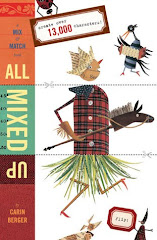
I meant to share the experience I had at the Hunter Elementary School book fair lecture. Sean Qualls and Carin Berger came in, both picture book illustrators, and both so talented. They showed pictures/slides of themselves as children and talked about their influences. Carin came from a designer background. She does collage. She showed us the first book she wrote when she was little and then we saw her work and realized how little many of her concepts had changed. Sean Qualls was terrific. He explained how he ran out of money during art school and had to quit--taking a full-time job at the Brooklyn museum, where he first learned about off-beat artistic folks like Ben Shahn, Romare Beardon, Jacob Lawrence--and other self taught artists.
He is married to the illustrator Selina Alko.
I will post their book jackets here soon.
I have discovered a few Hanukkah books and some nice Christmas books, as well.
The Runaway Dreidel by Leslea Newman and Moishe's Miracle by Laura Krauss Melmed both looked hip and current with gorgeous illustrations. I also ordered Mrs. Greenberg's Hanukkah by Linda Glasser. I will report back with reviews. My all-time favorite is When Mindy Saved Hanukkah by Barbara McClintock. You will love this book.
Two more books I found on several sites and heard folks talking about are: a reissue of the 1959 picture book The Blueberry Pie Elf by Jane Thayer. This is so adorable and the look will remind you of Garth Williams.
Another book being talked about is by Eden Ross Lipson, who recently passed away. She was in charge of the children's section at the NYT Book Review. She finished a book before she died called Applesauce Season, illustrated by the great Mordecai Gerstein. The woman in charge of Henry's afterschool program told me about the book with tears in her eyes. That's how much she adored it!
These days, in order to get Henry to read I have to literally shut of the television and say: "It's time to read." Tonight we read a translation of a French book--a Stepping Stone easy-to-read called The Ink Drinker by Eric Sanvoisin, illustrated by Martin Maatje. It was the story of a boy who hates books, but whose dad owns a book store. He notices a client drinking the ink out of books one day, and goes off to solve the mystery of why. Henry liked it, but it wasn't the most satisfying experience, I am sad to report. But it's a great introduction to creepier books meant for older kids! The cover really got me, and the art is pretty spectacular!
For the first night of Hanukkah, Gus got ABC-3D--also an import from France by Marion Bataille. If you haven't seen this video on youtube, it's very quaint and lots of fun.
But the next night he got The Book of Totally Irresponsible Science Experiments by Sean Connolly. He loved it!
He is finishing up a chess tournament, and when he comes home, I hope we can do some of the experiments...
Happy Holidays, and I will be back soon to post book jackets to go with this post.
I meant to share the experience I had at the Hunter Elementary School book fair lecture. Sean Qualls and Carin Berger came in, both picture book illustrators, and both so talented. They showed pictures/slides of themselves as children and talked about their influences. Carin came from a designer background. She does collage. She showed us the first book she wrote when she was little and then we saw her work and realized how little many of her concepts had changed. Sean Qualls was terrific. He explained how he ran out of money during art school and had to quit--taking a full-time job at the Brooklyn museum, where he first learned about off-beat artistic folks like Ben Shahn, Romare Beardon, Jacob Lawrence--and other self taught artists.
He is married to the illustrator Selina Alko.
I will post their book jackets here soon.
I have discovered a few Hanukkah books and some nice Christmas books, as well.
The Runaway Dreidel by Leslea Newman and Moishe's Miracle by Laura Krauss Melmed both looked hip and current with gorgeous illustrations. I also ordered Mrs. Greenberg's Hanukkah by Linda Glasser. I will report back with reviews. My all-time favorite is When Mindy Saved Hanukkah by Barbara McClintock. You will love this book.
Two more books I found on several sites and heard folks talking about are: a reissue of the 1959 picture book The Blueberry Pie Elf by Jane Thayer. This is so adorable and the look will remind you of Garth Williams.
Another book being talked about is by Eden Ross Lipson, who recently passed away. She was in charge of the children's section at the NYT Book Review. She finished a book before she died called Applesauce Season, illustrated by the great Mordecai Gerstein. The woman in charge of Henry's afterschool program told me about the book with tears in her eyes. That's how much she adored it!
These days, in order to get Henry to read I have to literally shut of the television and say: "It's time to read." Tonight we read a translation of a French book--a Stepping Stone easy-to-read called The Ink Drinker by Eric Sanvoisin, illustrated by Martin Maatje. It was the story of a boy who hates books, but whose dad owns a book store. He notices a client drinking the ink out of books one day, and goes off to solve the mystery of why. Henry liked it, but it wasn't the most satisfying experience, I am sad to report. But it's a great introduction to creepier books meant for older kids! The cover really got me, and the art is pretty spectacular!
For the first night of Hanukkah, Gus got ABC-3D--also an import from France by Marion Bataille. If you haven't seen this video on youtube, it's very quaint and lots of fun.
But the next night he got The Book of Totally Irresponsible Science Experiments by Sean Connolly. He loved it!
He is finishing up a chess tournament, and when he comes home, I hope we can do some of the experiments...
Happy Holidays, and I will be back soon to post book jackets to go with this post.
Sunday, October 25, 2009
Wild Things and World War II
I am sorry I haven't blogged in so long!
I have thought of you, dear blog readers, and
I apologize.
A recent visit to my son's second grade class
gave me a reminder to read all genres. We were
ignoring nonfiction, so I pulled something off the
shelf by a French illustrator named Jean-Louis Besson.
I don't know where or when I acquired this beautiful
book called October 45: Childhood Memories of the War
but his illustrations capture everything I have
always admired about French (and British) illustrators.
Friends often ask me when is the right time for The
Diary of Anne Frank. Well, that is a book for older kids--
ten and up. This one is perfect for kids from second to fifth
grade. It is told from the point of view of a French boy who
is not Jewish. What an introduction to World War II! The book
is fully illustrated in color and contains dozens of vignettes
that show what it was like for a child in France to be displaced
by a war--the details of which he is learning first hand.
It is not graphic/violent at all, but more like a slice of life
from those days--it reminds me of Au Revoir Les Enfants--the film by Louis Malle--about the
director's childhood in France during the war--at a Catholic
School where Jewish children are being hidden.
I also recommend this film as a wonderful introduction
to WWII if your children aren't quite ready for a film
set in a concentration camp. The Jean-Louis Besson
book is also terrific for parents to read aloud. I learned a lot.
I would also add that the reason The Diary
of Anne Frank is such a beloved book (besides the obvious) is that is tells the story of WWII and the Holocaust without bringing the reader inside the horror of the camps.
If you are looking for a great book for older kids--one which
is incredibly compelling and quite graphic, you may want
to look at The Fighter by Jean-Jacques Greif. I had a great experience working on the American
translation with the author. And it's the story of
Polish Jew taken by the Germans from Paris, a semi-professional boxer,
who survives Auschwitz. It's based on a true story, and it's utterly unbelievable.
The first chapters paint a lively portrait of anti-semitic Poland before the war--and it's got a great sense of Yiddish humor. It's a page turner, truly.
Now, if your child--or you--want to read another book about the war,
I recommend The Book Thief by Marcus Zusak. This award-winning book changed the way I saw writing, and lives with me. Though my son Gus (ten) found it too boring to read, I fell madly in love with it, and have a signed copy that I will leave to my grandchildren. The book is written from the p.o.v. of death, and Death as a narrator is not at all dry, but ironic, and very matter of fact about doing his job. I believe the book begins with a line that goes like this:
FACT: You will all die.
The story takes place on the German home front and is one of the most beautifully written, magnificently creative books ever--though I might add that some readers find it a bit over the top and show-offy. Because yes, it is mannered--but that was what I loved. I remember calling my dad to read him a section called The Jessie Owens incident.
Now just a few thoughts on the film version of Where the Wild Things Are.
I was apprehensive about seeing it because it looked very sad and I was afraid it would be boring. Well, it was very sad, but not boring at all.
I suppose I now realize (I saw it with Henry, seven)that kids like to see films that are sad and that we don't give them many opportunities to do this. The movie was chock-full of conflict--I mean, it's 90% conflict. The Wild Things--as characters--are jealous, oversensitive family members--or some type of commune--who have been pushing one anothers' emotional buttons for eternity. And I think the beauty of the film is that you are allowed to see all of these complicated, often ugly relationships through the eyes of Max--who has just run away because of conflicts at home he never knew how to escape. Wouldn't you run away sometimes? It's one things we forget kids can't really do.
So I watched and was completely absorbed--with a wad of tissues in my hand. And yup, it's very raw. For adults, there's hardly a feeling or reaction we don't deal with every day--jealousy, territoriality, disappointment, excitement, bragging, and the whole gamut--but for kids it's not often that so many of these emotions are enacted in one film. And it's only the rare animated film that even wants to approach these basic everyday issues. If you have been wanting to talk to your child about his emotions, this movie brings many of them to the surface. There is a lot of beauty in the film, and the original lines are spoken in several places. If you know the book, your heart will jump each time you hear a line. I wondered how the writers decided how extremely obnoxious to make the Wild Things. I mean, I found them to be a truly dysfunctional mess. I suppose it had to get pretty bad, or else Max wouldn't have wanted to go home at the end. I wondered if Maurice Sendak described some of his relatives to the writers to give them an idea of how far to go. When I think about it, it reminded me of sleeping over a friend's house when I was a kid--and the relief I would feel when I got to leave the next day, returning home to my own family and my own space and the familiarity of my own life. We had our dysfunctions, but at least had my own room to escape to and my own things, and they were mine.
I have thought of you, dear blog readers, and
I apologize.
A recent visit to my son's second grade class
gave me a reminder to read all genres. We were
ignoring nonfiction, so I pulled something off the
shelf by a French illustrator named Jean-Louis Besson.
I don't know where or when I acquired this beautiful
book called October 45: Childhood Memories of the War
but his illustrations capture everything I have
always admired about French (and British) illustrators.
Friends often ask me when is the right time for The
Diary of Anne Frank. Well, that is a book for older kids--
ten and up. This one is perfect for kids from second to fifth
grade. It is told from the point of view of a French boy who
is not Jewish. What an introduction to World War II! The book
is fully illustrated in color and contains dozens of vignettes
that show what it was like for a child in France to be displaced
by a war--the details of which he is learning first hand.
It is not graphic/violent at all, but more like a slice of life
from those days--it reminds me of Au Revoir Les Enfants--the film by Louis Malle--about the
director's childhood in France during the war--at a Catholic
School where Jewish children are being hidden.
I also recommend this film as a wonderful introduction
to WWII if your children aren't quite ready for a film
set in a concentration camp. The Jean-Louis Besson
book is also terrific for parents to read aloud. I learned a lot.
I would also add that the reason The Diary
of Anne Frank is such a beloved book (besides the obvious) is that is tells the story of WWII and the Holocaust without bringing the reader inside the horror of the camps.
If you are looking for a great book for older kids--one which
is incredibly compelling and quite graphic, you may want
to look at The Fighter by Jean-Jacques Greif. I had a great experience working on the American
translation with the author. And it's the story of
Polish Jew taken by the Germans from Paris, a semi-professional boxer,
who survives Auschwitz. It's based on a true story, and it's utterly unbelievable.
The first chapters paint a lively portrait of anti-semitic Poland before the war--and it's got a great sense of Yiddish humor. It's a page turner, truly.
Now, if your child--or you--want to read another book about the war,
I recommend The Book Thief by Marcus Zusak. This award-winning book changed the way I saw writing, and lives with me. Though my son Gus (ten) found it too boring to read, I fell madly in love with it, and have a signed copy that I will leave to my grandchildren. The book is written from the p.o.v. of death, and Death as a narrator is not at all dry, but ironic, and very matter of fact about doing his job. I believe the book begins with a line that goes like this:
FACT: You will all die.
The story takes place on the German home front and is one of the most beautifully written, magnificently creative books ever--though I might add that some readers find it a bit over the top and show-offy. Because yes, it is mannered--but that was what I loved. I remember calling my dad to read him a section called The Jessie Owens incident.
Now just a few thoughts on the film version of Where the Wild Things Are.
I was apprehensive about seeing it because it looked very sad and I was afraid it would be boring. Well, it was very sad, but not boring at all.
I suppose I now realize (I saw it with Henry, seven)that kids like to see films that are sad and that we don't give them many opportunities to do this. The movie was chock-full of conflict--I mean, it's 90% conflict. The Wild Things--as characters--are jealous, oversensitive family members--or some type of commune--who have been pushing one anothers' emotional buttons for eternity. And I think the beauty of the film is that you are allowed to see all of these complicated, often ugly relationships through the eyes of Max--who has just run away because of conflicts at home he never knew how to escape. Wouldn't you run away sometimes? It's one things we forget kids can't really do.
So I watched and was completely absorbed--with a wad of tissues in my hand. And yup, it's very raw. For adults, there's hardly a feeling or reaction we don't deal with every day--jealousy, territoriality, disappointment, excitement, bragging, and the whole gamut--but for kids it's not often that so many of these emotions are enacted in one film. And it's only the rare animated film that even wants to approach these basic everyday issues. If you have been wanting to talk to your child about his emotions, this movie brings many of them to the surface. There is a lot of beauty in the film, and the original lines are spoken in several places. If you know the book, your heart will jump each time you hear a line. I wondered how the writers decided how extremely obnoxious to make the Wild Things. I mean, I found them to be a truly dysfunctional mess. I suppose it had to get pretty bad, or else Max wouldn't have wanted to go home at the end. I wondered if Maurice Sendak described some of his relatives to the writers to give them an idea of how far to go. When I think about it, it reminded me of sleeping over a friend's house when I was a kid--and the relief I would feel when I got to leave the next day, returning home to my own family and my own space and the familiarity of my own life. We had our dysfunctions, but at least had my own room to escape to and my own things, and they were mine.
Friday, September 11, 2009
Mr. Catalonia Had Pneumonia
This summer, I tried to photograph kids
reading. I managed to find some kids reading on
bikes and one on a hula hoop. But I must admit that
while my family vacationed in and around Barcelona,
reading was not the main activity I noticed. I would
say the north east coast of Spain, known as Catalunya
was all about the swimming. Alternating between day
trips to Barcelona and beach towns and coves in the Costa Brava,
our base was in a sleepy beach town called Premia de Mar.
It was six or so villages up the coast from BCN, and we used a
train to get to the city.
I began the trip reading Middlesex by Jeff Eugenides, and finished it half way through.
I read it on my iphone kindle,and read it obsessively.
It's not a perfect book, but the
narrator's gender switches around, and this detail makes the
book fascinating and unique. It reminded me a little bit of
The Danish Girl.
PLease read this book and then call me so we can talk about it.
Its theme of immigrant life in America was fitting for a stranger
in a new land--i.e. me in Spain.
Gus read the entire Septimus Heap series (4 books) very speedily.
He read whatever else I had. He read Half Magic, The Doll's House by Rumor Godden,
the second Benedict Society book, and many more. We are running out of books for him to read.
I picked up When You Reach Me by Rebecca Stead, who lives on the Upper West Side. But for the end of the trip I read The Family Markowitz by Allegra Goodman. She is a strong, interesting writer, but the voice reminded me too much of Middlesex, and that was confusing. Also, there seemed to be no child characters, and that seemed foreign to me.
While in Spain I never ran out of things to notice.
I kept making lists in my head.
And so I will try and recreate one of these lists below.
Things I noticed in Spain:
1. A lot of piercings, tattoos, and chic hippie clothes.
2. Muslims comfortably enmeshed in every day society.
3. Almost no artificially colore blond hair on women or men.
3b. The mullet is alive and well and stylish in Catalunya.
Also, long braids and many a dreadlock.
4. The "x" makes the "she" sound. Chocolate = xiocolate
5. Everything closes from 2 to 4:30, and from around 5 to 9 pm
everyone seems to be outside relaxing after the hot sun takes a break.
6. 30 to 50% of women are topless at the beaches, depending where you are.
And there are beaches up North with castles on them.
7. I never saw a childrens book store, nor did I see children reading.
8. The grocery store sells many types of sangria and bubbly spring water.
9. The salt is chunkier and very tasty. The coffee is stronger. Fanta tastes a bit like Orangina and is an acceptable beverage. Coke Light is very popular!
10. Donuts have replaced the fried dough Churros, known as xurros in Catalunya!
11. Most fashions can be found at the flea market and (some)clothing is inexpensive.
12. Cured meats are everywhere and delicious and addictive.
13. We (USA) wear more solid clothing, they don't. The big fashion right now is genie pants in all shapes with "t" back t-shirts.
14. Nacho chips are not easy to find.
15. The following fashion companies are from Spain: Custo, Zara, Desigual (new in Soho!!) Camper shoes. They have outlets similar to Woodbury Commons.
16. There is a Catalunyan national shoe we saw on hundreds and hundreds of people. It is a type of leather sandal.
17. In Barcelona, there are a lot of people in commuter train stations to help you.
18. You can swim in the Olympic pool which was used in the 1992 Summer Games and it's really fun.
19. The big artists of the area are: Dali, Miro, Picasso, and Gaudi. This combination makes for a very funky artistic p.o.v.
20. Barcelona is like Paris + Nice + San Francisco and more. It was really, truly, a beautiful city.
21. Instead of having Sponge Bob everywhere, they have the Simpsons everywhere!
Soon I will hunt for photos to add to this posting and write some more about the trip. In case I didn't mention, Henry had pneumonia while we were away. But that is a story for another day. Good night!
reading. I managed to find some kids reading on
bikes and one on a hula hoop. But I must admit that
while my family vacationed in and around Barcelona,
reading was not the main activity I noticed. I would
say the north east coast of Spain, known as Catalunya
was all about the swimming. Alternating between day
trips to Barcelona and beach towns and coves in the Costa Brava,
our base was in a sleepy beach town called Premia de Mar.
It was six or so villages up the coast from BCN, and we used a
train to get to the city.
I began the trip reading Middlesex by Jeff Eugenides, and finished it half way through.
I read it on my iphone kindle,and read it obsessively.
It's not a perfect book, but the
narrator's gender switches around, and this detail makes the
book fascinating and unique. It reminded me a little bit of
The Danish Girl.
PLease read this book and then call me so we can talk about it.
Its theme of immigrant life in America was fitting for a stranger
in a new land--i.e. me in Spain.
Gus read the entire Septimus Heap series (4 books) very speedily.
He read whatever else I had. He read Half Magic, The Doll's House by Rumor Godden,
the second Benedict Society book, and many more. We are running out of books for him to read.
I picked up When You Reach Me by Rebecca Stead, who lives on the Upper West Side. But for the end of the trip I read The Family Markowitz by Allegra Goodman. She is a strong, interesting writer, but the voice reminded me too much of Middlesex, and that was confusing. Also, there seemed to be no child characters, and that seemed foreign to me.
While in Spain I never ran out of things to notice.
I kept making lists in my head.
And so I will try and recreate one of these lists below.
Things I noticed in Spain:
1. A lot of piercings, tattoos, and chic hippie clothes.
2. Muslims comfortably enmeshed in every day society.
3. Almost no artificially colore blond hair on women or men.
3b. The mullet is alive and well and stylish in Catalunya.
Also, long braids and many a dreadlock.
4. The "x" makes the "she" sound. Chocolate = xiocolate
5. Everything closes from 2 to 4:30, and from around 5 to 9 pm
everyone seems to be outside relaxing after the hot sun takes a break.
6. 30 to 50% of women are topless at the beaches, depending where you are.
And there are beaches up North with castles on them.
7. I never saw a childrens book store, nor did I see children reading.
8. The grocery store sells many types of sangria and bubbly spring water.
9. The salt is chunkier and very tasty. The coffee is stronger. Fanta tastes a bit like Orangina and is an acceptable beverage. Coke Light is very popular!
10. Donuts have replaced the fried dough Churros, known as xurros in Catalunya!
11. Most fashions can be found at the flea market and (some)clothing is inexpensive.
12. Cured meats are everywhere and delicious and addictive.
13. We (USA) wear more solid clothing, they don't. The big fashion right now is genie pants in all shapes with "t" back t-shirts.
14. Nacho chips are not easy to find.
15. The following fashion companies are from Spain: Custo, Zara, Desigual (new in Soho!!) Camper shoes. They have outlets similar to Woodbury Commons.
16. There is a Catalunyan national shoe we saw on hundreds and hundreds of people. It is a type of leather sandal.
17. In Barcelona, there are a lot of people in commuter train stations to help you.
18. You can swim in the Olympic pool which was used in the 1992 Summer Games and it's really fun.
19. The big artists of the area are: Dali, Miro, Picasso, and Gaudi. This combination makes for a very funky artistic p.o.v.
20. Barcelona is like Paris + Nice + San Francisco and more. It was really, truly, a beautiful city.
21. Instead of having Sponge Bob everywhere, they have the Simpsons everywhere!
Soon I will hunt for photos to add to this posting and write some more about the trip. In case I didn't mention, Henry had pneumonia while we were away. But that is a story for another day. Good night!
Subscribe to:
Posts (Atom)


.jpg)
.jpg)

.jpg)
.jpg)
















 Posts
Posts

